

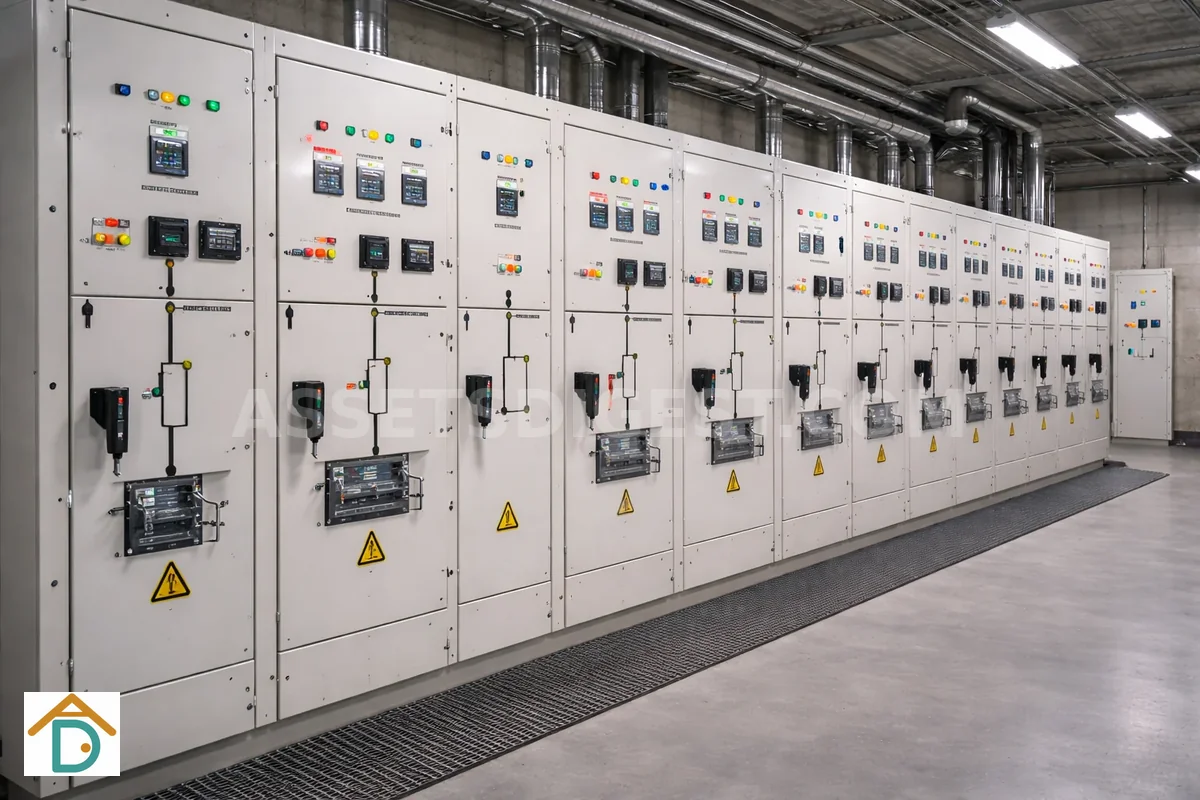
The electrical panel, also called the main distribution board (MDB), is the nerve centre of a unit’s power supply. It tells you, at a glance, what the unit has, how it was last used, and whether it has room to grow. A five-minute inspection during a viewing can reveal constraints that building management will not volunteer.
Ask the landlord or agent to open the panel before you commit. If they refuse or deflect, that itself is a signal worth noting.
Where to Find the Electrical Panel
In most Singapore industrial units, the MDB is near the main entrance or in a dedicated utility area. It is usually a wall-mounted metal enclosure. In older buildings, it may be at the end of a corridor or in a shared electrical room.
If the panel is locked, ask for it to be opened. You are assessing a major infrastructure commitment. You have the right to inspect.
What to Look At
Main Breaker Rating
The largest breaker at the top of the panel (the main disconnect) indicates the unit’s maximum supply capacity. It will be labelled in amperes: 60A, 100A, 200A, 400A.
A quick conversion helps you compare to your needs:
- Single-phase 230V: 60A = ~13.8 kVA (~11.7 kW usable at PF 0.85)
- Three-phase 400V: 100A per phase = ~69.3 kVA (~59 kW usable at PF 0.85)
If your estimated demand (from your equipment list) exceeds what this main breaker can deliver, the unit cannot serve your operation without an upgrade, regardless of what the agent tells you about “available power.”
Phase Configuration
Look for labels inside the panel cover:
- “L1, L2, L3” or “R, Y, B”: these indicate three-phase. Three live conductors.
- “L, N” (Live, Neutral) only: single-phase. Two wires.
If you need three-phase power for motors, compressors, or industrial ovens and the panel shows only L and N, you have a fundamental mismatch.
Number and Type of Circuit Breakers
More circuits mean more flexibility for distributing power to different areas or equipment types. Look at whether the breakers are:
- Single-phase (one-pole) breakers: typically for lighting and standard outlets
- Three-phase breakers: larger, with three switches ganged together, for heavy equipment circuits
Are there unused breaker slots in the panel? Unused slots mean room to add circuits without replacing the panel. If all slots are full, any expansion requires a panel upgrade.
Panel Condition
Open the panel cover fully and look inside:
- Clean, organised wiring with proper cable management: the previous tenant or building had professional electrical work done
- Exposed wires, burnt marks, discolouration on bus bars or breakers: overloading history or loose connections
- Corrosion especially in humid environments or units previously used for food production: moisture has gotten into the panel
- Makeshift wiring: taped joints, jury-rigged extensions, daisy-chained circuits, indicating ad-hoc additions, not professional installation
- Missing breaker blanks: open slots without protective covers are a safety hazard and suggest incomplete work
Labelling
Are the circuits labelled? Good practice in any commercial installation is to label each breaker with its function: “Lighting-Zone A,” “Cold Room,” “Exhaust Fan-1.” Clear labelling means the electrical installation was done properly and documented.
No labels at all means the panel has been added to incrementally by different contractors over time, and you may be inheriting someone else’s problem.
Red Flags That Should Stop You
These conditions do not automatically mean walk away, but they mean you need a professional inspection before committing:
- Burn marks or discolouration on breakers or the bus bar inside the panel
- Corrosion on terminals or breaker contacts
- Any evidence of flooding or water ingress (staining, warped components)
- A panel where every breaker slot is full and there are additions wired outside the panel (a telltale sign of overflow work)
- A very old panel: fuse-based boards or panels with obsolete breaker types that are no longer readily available
- Makeshift wiring inside the panel enclosure
Questions to Ask During or After the Viewing
- What is the total electrical allocation for this unit, in kVA or amperes?
- Is the supply single-phase or three-phase? (Confirm what you saw in the panel.)
- When was the electrical system last inspected or upgraded?
- Did the previous tenant make any modifications to the panel or internal wiring?
- Is there spare transformer capacity in the building for future upgrades?
- Can I engage my own LEW to conduct a formal inspection before I commit?
For step-by-step guidance on estimating the power you need and comparing it to what the unit provides, see How to Estimate Power Needs. For cost ranges and timelines for addressing an inadequate supply, see Power Upgrade Costs & Timelines.
References
[1] EMA — Electrical Worker Licences. https://www.ema.gov.sg/regulations-licences/licences/worker-licences/electrical-technicians-licence
[2] SP Group — How to Apply for Electricity Connection (Handbook). https://www.spgroup.com.sg/dam/jcr:66289889-80d2-4559-a479-a804d5323f19/How%20to%20Apply%20for%20Electricity%20Connection.pdf
[3] EMA — Acts & Regulations (Electricity Supply). https://www.ema.gov.sg/regulations-licences/regulations/acts-regulations
[4] EMA — Electricity Legislation and Regulations. https://www.ema.gov.sg/Licensees_Electricity_Legislation_and_Regulations.aspx
[5] SCDF — Fire Safety Guidelines. https://www.scdf.gov.sg/home/community-and-volunteers/fire-emergency-guides/fire-safety-guidelines-for--residential-estate
[6] JTC Corporation — Industrial Space Information. https://www.jtc.gov.sg/find-space/