

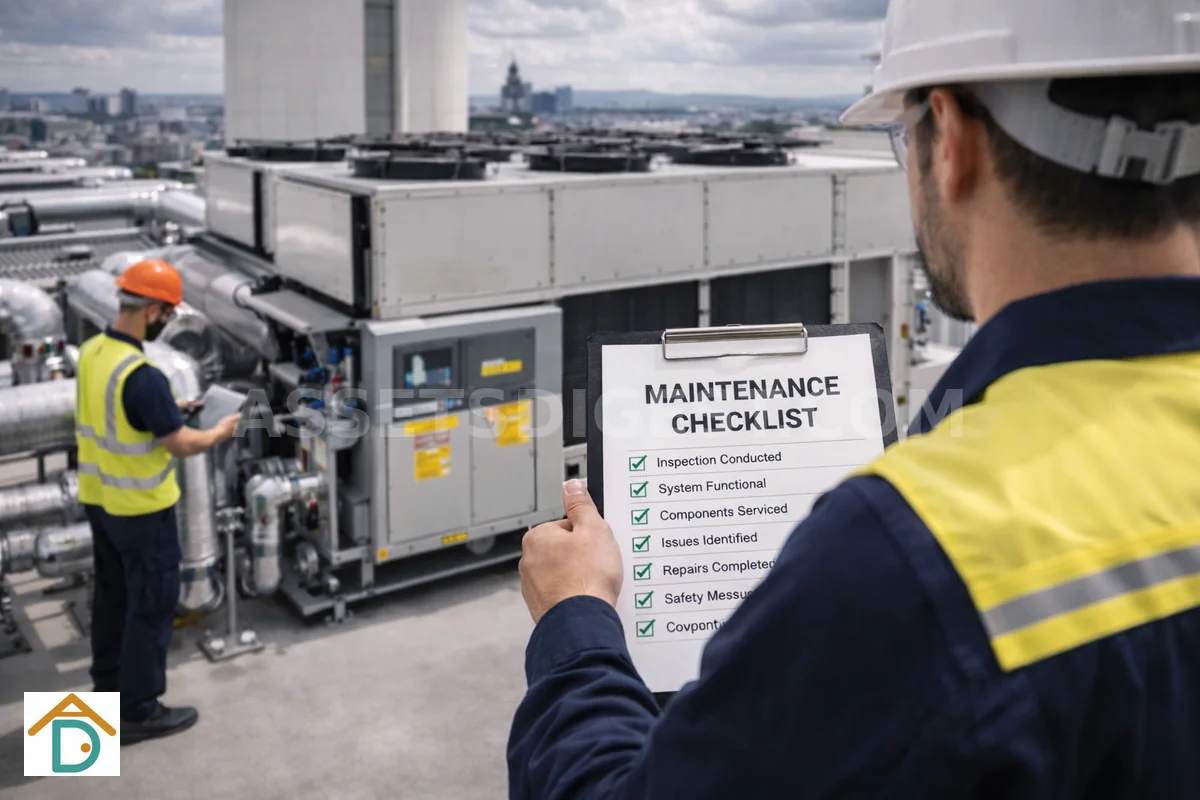
You installed a powerful exhaust fan, but smoke still lingers and doors feel heavy. The problem isn’t the fan. It’s the air supply. Without replacement air flowing in, the exhaust system cannot pull air out effectively. This is the single most commonly missed constraint in industrial exhaust planning, and it is rarely flagged by contractors who have not worked in industrial buildings before.
This post is for food factory operators installing cooking exhaust systems, any industrial tenant with exhaust-intensive operations such as welding fume extraction, chemical ventilation, or powder coating, and building managers troubleshooting tenant complaints about poor exhaust performance. It explains why make-up air is the hidden determinant of exhaust performance, how negative pressure reveals itself during viewings, and what to check before you commit to a unit.
Make-Up Air as the Missing Piece
The parent pillar story runs this way: a tenant signs the lease for a central kitchen unit, plans the exhaust duct routing, and then discovers the building has no available shaft capacity and external mounting is prohibited. The cooking equipment is already ordered, the opening is in three months, and there is no viable path to the roof. That story focuses on duct routing as the structural constraint. But the failure mode that is equally common, and equally preventable with a simple viewing check, is the absence of make-up air. Even a correctly routed exhaust system will not function if the unit has no path for replacement air to enter. This article covers that second, independent constraint.
For the full exhaust and ventilation overview, see the Exhaust / Ventilation / Odour Control Basics pillar. Go there first for the full overview of exhaust system components and how they interact.
How Exhaust Creates Negative Pressure
Exhaust fans remove air from the unit. For the system to function, fresh air must enter to maintain pressure balance. Without make-up air, negative pressure builds quickly. The exhaust fan continues to run but cannot move air efficiently: it is effectively pushing against a vacuum.
The physics are straightforward: for every cubic metre of air the exhaust removes, a cubic metre of air must enter somewhere. If there is no path for air to enter, the exhaust fan simply creates a partial vacuum. The fan motor spins, the hood is there, but nothing is actually being exhausted.
Signs of Make-Up Air Problems
Doors feeling heavy or pulling shut on their own is a clear indicator. If opening a door requires significant force and the door then slams shut, the unit is under negative pressure.
Exhaust hoods that perform poorly despite the fan running at full speed indicate insufficient air replacement. The fan is moving, but no air is available to move.
Staff complaints about stuffiness or lingering odours often trace back to inadequate air change, not exhaust fan failure.
Backdrafting (air flowing backward through openings that should exhaust outward) occurs when negative pressure reverses the intended flow direction. This can pull exhaust fumes and odours into adjacent corridors or neighbouring units.
Solutions
Passive make-up air uses louvred openings, windows, and transfer grilles to allow air to enter naturally. This approach is simple and low-cost but has limited capacity and is ineffective in tightly sealed buildings. It also has drawbacks: security risk from open windows, pest entry, weather exposure, and limited control in changing wind conditions.
Mechanical make-up air uses a dedicated fan to supply fresh air matched to exhaust volume. This is more reliable and controllable but adds capital cost and energy consumption. Make-up air volume should be approximately 80–90% of exhaust volume to maintain slight negative pressure: enough to keep contaminants flowing toward the hood, but not so much that the unit becomes a vacuum.
What to Check During Viewings
Ask whether the unit has make-up air provision. Turn on any existing exhaust and feel for pressure at doors and windows. If doors pull inward or air feels difficult to move, negative pressure is present.
Check for openable windows or wall louvres. If the unit is fully sealed with no path for air to enter, make-up air is absent.
Where make-up air is absent, assess whether installing it is feasible before committing. Adding mechanical make-up air mid-fit-out is more costly than planning for it at the start.
Summary and Next Steps
Exhaust systems require replacement air to function. Without make-up air, negative pressure prevents effective exhaust performance regardless of fan capacity. Signs include doors pulling shut, poor hood performance, staff complaints, and backdrafting. Solutions range from passive louvres to mechanical supply fans. During viewing, check for existing provision and feasibility of installation if absent.
Quick Reference Checklist
- Check for existing louvres, windows, or transfer grilles: any opening that allows air to enter
- Turn on any existing exhaust and observe door behaviour: doors pulling inward signal negative pressure
- Ask building management about mechanical make-up air options if passive provision is absent
- If no provision exists, factor installation cost into your decision before signing
- Ensure make-up air does not draw from contaminated areas such as parking lots or waste bin centres
- Confirm make-up air volume is roughly 80–90% of exhaust volume to maintain slight negative pressure
For the full exhaust and ventilation overview, see Exhaust / Ventilation / Odour Control Basics.
For rooftop duct routing constraints, see Rooftop Duct Routing.
For noise control basics, see Noise Control Basics.
For grease duct maintenance, see Grease Duct Maintenance.
For the exhaust system viewing checklist, see Viewing Checklist: Exhaust System Condition.
For SCDF fire safety basics, see SCDF Fire Safety Basics.
References
[1] NEA: Air Pollution Control — Exhaust and Emissions. https://www.nea.gov.sg/our-services/pollution-control [2] SCDF: Acts, Codes & Regulations (Fire Safety). https://www.scdf.gov.sg/fire-safety-services-listing/downloads/acts-codes-and-regulations [3] SCDF: Fire Safety (Buildings) Regulations. https://www.scdf.gov.sg/fire-safety-services-listing/downloads/acts-codes-and-regulations [4] ASHRAE: Ventilation for Acceptable Indoor Air Quality (reference standard). https://www.ashrae.org [5] MOM: Workplace Safety & Health. https://www.mom.gov.sg/workplace-safety-and-health [6] BCA: Building Plan Submission. https://www1.bca.gov.sg/safety-and-standards/building-control-act/ [7] JTC: Industrial Space. https://www.jtc.gov.sg/find-space/