

For industrial occupiers around Mandai and Sungei Kadut, the proposition behind KeyStone @ Mandai is straightforward: secure a freehold operating base instead of remaining exposed to lease renewals. But tenure is only part of the decision. Whether a unit actually works depends on the approved use, floor loading, power provision, vehicle access and the economics of the eventual exit.
The approved-use question is the one most buyers skim past. B2. URA zones B2 developments for general and special industries, but that doesn’t mean every heavier trade is automatically a permitted use, and it doesn’t mean every unit in a B2 building is fitted out the same way.
KeyStone @ Mandai, a 69-unit freehold B2 development at 2C Mandai Estate, is worth a closer look for that reason. Get the zoning fit and unit specs right, and a buyer locks in a genuinely scarce freehold operating base. Get it wrong, and freehold tenure does nothing to fix a unit that can’t run the business it was bought for.
What this analysis is for
This is for business owners who already know they need heavier zoning than B1 allows: automotive repair, carpentry, machining, production studios, heavy warehousing. It’s for investors weighing freehold industrial against the leasehold stock that makes up most of JTC’s portfolio. And it’s for agents who need to answer a client’s compliance questions before the sales gallery gets to the headline price.
By the end, readers should be able to separate what’s effectively fixed by URA’s zoning rules from what’s still a deal-specific variable: entry price, unit selection, and whether the numbers still work once the likely occupier profile for a B2 building is priced in. If B1 and B2 aren’t already clear in your head, start with the B1 vs B2 guide first. This analysis assumes that foundation.
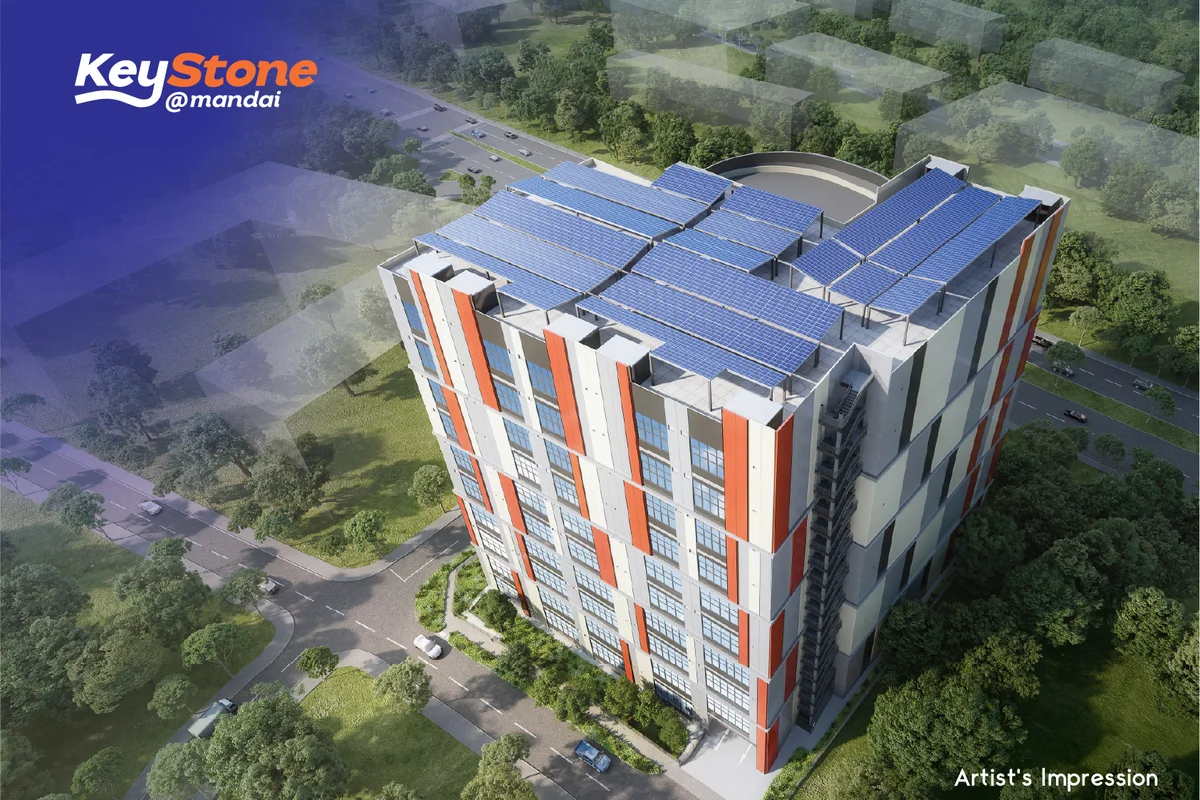
Where KeyStone fits in the freehold conversation
Most industrial buyers approach a launch with one of three motivations in mind: a long-term operating base they control instead of rent, a non-residential asset that sits outside ABSD, or a scarce freehold position that leasehold supply can’t replace later.
KeyStone @ Mandai sits at that intersection, with one added filter. URA’s B2 framework is broader than B1 in what it permits, covering general and special industries on top of everything B1 already allows, subject to approval. The practical occupier pool, though, may differ from a typical B1 development because KeyStone is positioned and specified around heavier industrial use, in an industrial-first Mandai location. In AssetsDigest’s view, that positioning is more likely to draw a specialised resale and leasing pool than a centrally located B1 strata factory would, even though B2 zoning itself doesn’t exclude B1-type tenants.
Freehold land zoned specifically for B2 use is limited to begin with, since most of Singapore’s newer multi-user industrial stock is leasehold, developed and released by JTC or private developers on 30 to 60-year terms. A freehold B2 launch reaching the open market at meaningful scale, 69 units across ten storeys, doesn’t happen often. That scarcity supports a premium. It does not, on its own, guarantee the premium is justified.
Project snapshot
| Item | Details |
|---|---|
| Project | KeyStone @ Mandai |
| Address | 2C Mandai Estate, Singapore 729900 |
| Location | Mandai Industrial Zone, Sungei Kadut / Woodlands corridor |
| Tenure | Freehold (Estate in Fee Simple) |
| Zoning | B2 Industrial |
| Land Size | 4,779.90 sqm |
| Storeys | 10 storeys plus basement |
| Units | 69 (including 1 industrial canteen unit) |
| Building Plan No | A1590-00626-2024-BP01, dated 12 March 2025 |
| Expected Vacant Possession | 31 December 2028 |
| Expected Legal Completion | 31 December 2031 |
| Carpark / Motorcycle / Bicycle Lots | 32 / 2 / 40 |
| Developer | Bayswood Pte Ltd |
A ten-storey, ramp-up B2 building on a freehold site of this size is uncommon. That combination matters because it stacks three separate scarcity factors together: freehold tenure, B2 zoning, and a multi-storey ramp-up format that most older flatted-factory stock in the area doesn’t offer.[1]
B2 is not just a heavier version of B1
KeyStone @ Mandai markets itself for import and export, general office, warehousing, production, creative pursuits, trading, carpentry workshops, automotive workshops and heavy warehousing. That range only makes sense once the zoning behind it is understood correctly.
URA defines B1 zones as permitting clean and light industries. B2 zones permit general and special industries, a materially broader category that covers more industrial intensity, not a stricter or more exclusive one. NEA requires a 100-metre nuisance buffer between a B2 zone and the surrounding area, which is why B2 sites are typically planned away from residential neighbourhoods, and why Mandai, an established industrial pocket, is a plausible B2 location in the first place.[2] That buffer sits at the zone level; it doesn’t mean each individual business activity is separately “tested” against it. What matters for a specific tenant is whether its proposed use is a permitted activity under B2, and whether it can secure the operational and environmental approvals the relevant authorities require.
Like B1, B2 developments carry a use quantum rule: at least 60% of the total B2 industrial GFA must be used for industrial purposes, with the remaining 40% available for ancillary or supporting use such as offices.[3] For a multi-user project such as KeyStone, that rule applies both at development level and within each strata-subdivided unit: URA expects each individual industrial unit to keep at least 60% of its own floor area in predominant industrial use, capped at 40% ancillary.[3]
The practical upshot for buyers: a B2 unit can house activities a B1 building would reject, such as heavier machining, automotive workshops or noisier production work. But B2 status doesn’t mean unrestricted use. A buyer whose activity already fits comfortably within B1 parameters may derive little operational benefit from B2 zoning, so any premium over a comparable B1 unit should be justified by the building, tenure, location and specifications, not by the B2 label alone. Cross-check any specific business activity against the industrial activity matrix before assuming it qualifies.
Reading the Mandai location
KeyStone sits within the Mandai Industrial Zone, roughly five minutes from JTC’s Sungei Kadut Eco-District and the Gali Batu Industrial Estate. Sungei Kadut is JTC’s 500-hectare masterplan to anchor agri-tech, environmental technology and recycling industries, including Singapore’s first multi-storey recycling facility and a planned new MRT station on the corridor.[4]
From KeyStone, it’s roughly an 8-minute drive to Woodlands Checkpoint, 7 minutes to Kranji MRT, 11 minutes to the Woodlands Regional Centre and 12 minutes to Woodlands North MRT, with direct access to the BKE, SLE and KJE. For a business with regular Johor Bahru traffic or Woodlands-based clients, that checkpoint proximity is an operational advantage, not just a commuting convenience.
The area is still industrial-first rather than mixed-use. Nearby occupiers include Lineage Logistics and dormitory housing at Westlite Mandai and Westlite Juniper, with the former Singapore Racecourse site earmarked for eventual residential use under the longer-term URA masterplan.[5] Buyers should treat that longer-term rezoning as background context, not a near-term catalyst. Confirm current zoning on the specific plot through URA’s Master Plan tool rather than relying on a brochure map.[5]
Inside the building: the specs that decide whether it works
Freehold and zoning headlines get buyers to the sales gallery. Floor loading, power and loading access decide whether a unit actually runs the business.
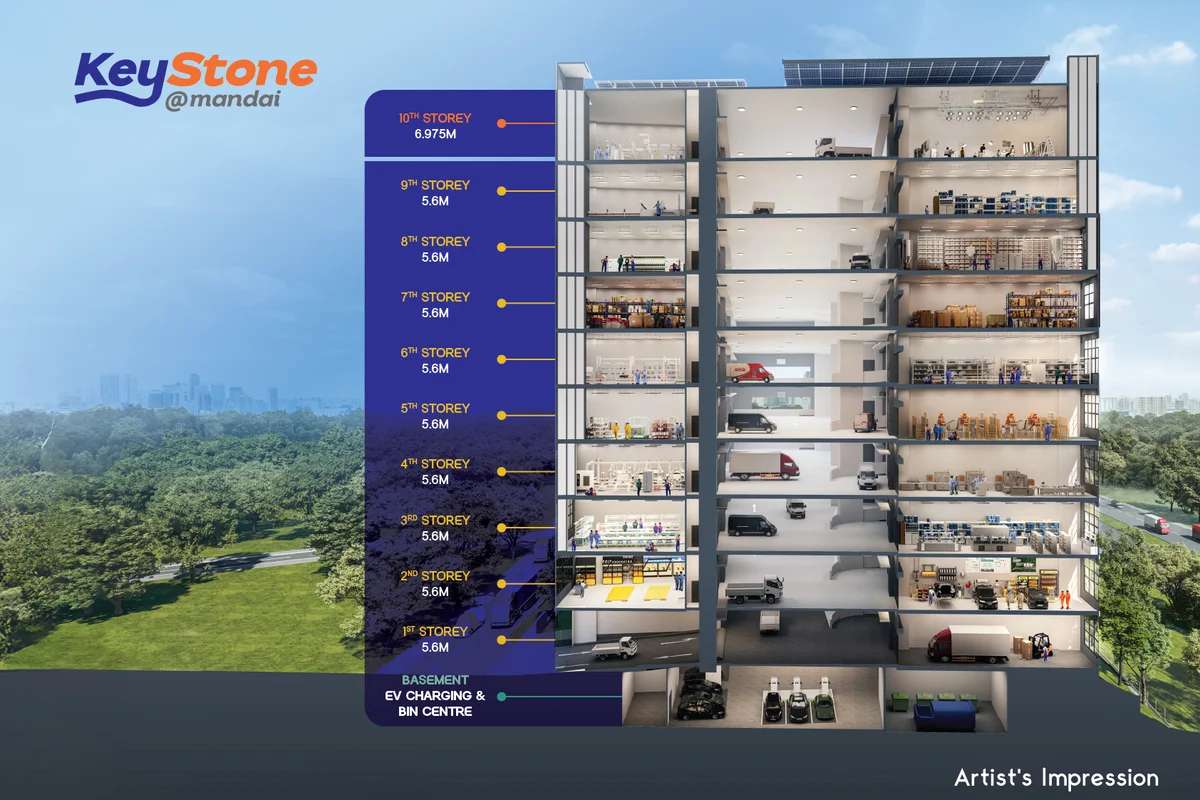
Every level, from the 1st storey to the 10th, is rated at 15kN/m² live load for both the production area and the driveway or ramp area. That’s a detail worth noting on its own: many multi-storey industrial buildings reduce floor loading on upper floors, which quietly rules out heavier equipment above a certain level. KeyStone doesn’t do that here, which widens which storeys can take heavy machinery or racking.
Ceiling heights run at 5.6m from the 1st to the 9th storey, stepping up to 6.975m on the 10th. Electrical power is tiered by level too: 150A three-phase on Levels 1 and 2, dropping to 100A three-phase from Level 3 to Level 10. That pattern points to the lower floors being designed for the more power-intensive tenants, with upper floors better suited to storage, lighter assembly or office-heavy operations.
Loading is where the ramp-up design earns its keep. Level 1 has one 20-footer container loading and unloading bay, with a forklift provided by the developer, plus one 14-footer lorry lot. The basement adds two more 14-footer lorry lots. Vehicles up to 14ft rigid (under 7.5m) can drive directly onto Levels 2 through 10, with the ramp driveway narrowing from 12m at Level 1 to 7.4m from Level 2 upward, and a height barrier of 4.5m at ground level tightening to 3.5m above it.[1] Businesses running larger trucks or taller vehicles need to check their fleet against those exact clearances before assuming every level is accessible.
Lifts are split by function: two passenger lifts rated at 825kg, and two goods lifts rated at 2,500kg. Every unit gets its own roller shutter and separate door access, with shutter widths varying by unit stack, and the layouts are column-free, which matters more than it sounds for racking and production-line flexibility. Amalgamation between adjoining units is possible, subject to authority approval, for buyers who may want to combine stacks later.[1]
The canteen unit is the exception, not the template
One detail in the fact sheet is easy to miss and important to get right: KeyStone’s single industrial canteen unit, #01-06 on the 1st storey, is the only unit fitted with a grease trap and a dedicated kitchen exhaust duct (KED) capped off at roof level for tenant connection. The other 68 units don’t get either.
That’s a meaningful distinction for anyone assuming a food-related or F&B-support use is straightforward across the building. It isn’t. A buyer planning a food-prep, catering or similar operation needs to confirm whether they’re purchasing the canteen unit specifically, or whether their intended use even qualifies for the ancillary-use allowance under B2’s 60/40 GFA rule in a standard factory unit. Toilets, by contrast, are provided at the front of every unit, and waterproofing is only built into the toilet and bin room; the owner is responsible for any additional waterproofing needed to protect the production area and neighbouring units.[1]
Running costs and the everyday features
KeyStone’s sustainability features are practical rather than headline-driven. Solar panels go on the rooftop after TOP to offset building utility costs, and every unit is EV-charger-ready, with wiring run from the distribution board to a fixed point; the owner installs the actual charger. Parking runs on an ERP hourly system, and the building has 24-hour access-controlled security.
Waste is handled through a designated bin point at every unit from Level 1 to 10, with cleaners collecting daily to a basement bin centre. Each unit has at least one floor trap with a 50mm drainage drop, and lift lobby ventilation is mechanical at the basement, natural everywhere else.[1] None of this is a deal-breaker, but it’s the kind of detail that shows up in the MCST budget later, worth factoring into holding costs rather than assuming freehold means cheap to run.
The no-ABSD case, and where the real costs sit
Industrial property, B1 or B2, sits outside residential ABSD. IRAS computes ABSD on the purchase price or market value of residential property specifically, whichever is higher, which gives non-residential assets a structural advantage for buyers already carrying residential exposure.[6]
That advantage gets oversold more often than it should. Buyers of KeyStone still need to budget for:
- Buyer’s Stamp Duty
- GST, where applicable
- Property tax
- Legal fees
- Bank loan terms and interest rate
- MCST fees
- Rental downtime and leasing commission, for investment buyers
- Industrial Seller’s Stamp Duty if sold within the holding period
For non-residential property, IRAS computes BSD on the purchase price or market value, whichever is higher, with a top marginal BSD rate of 5% for non-residential property from 15 February 2023.[7] Seller’s Stamp Duty applies to industrial properties and industrial land acquired on or after 12 January 2013 and disposed of within the holding period.[8]
| Holding Period | Industrial SSD Rate |
|---|---|
| Up to 1 year | 15% |
| More than 1 year and up to 2 years | 10% |
| More than 2 years and up to 3 years | 5% |
| More than 3 years | No SSD payable |
No ABSD is a real cost advantage. It is not, by itself, a reason to accept a stretched entry price.
Who KeyStone actually suits
The B2 use profile narrows this down more than the marketing suggests. The building suits businesses that genuinely need what B1 doesn’t offer: automotive workshops needing hoists and higher noise tolerance, carpentry or metalwork producing dust and vibration, heavy warehousing needing full-height racking and container access, or production studios needing more flexible activity classification than a clean-industry building allows.
For an owner-occupier, the case is straightforward if the business already operates in a B2-appropriate trade near Mandai or Sungei Kadut and expects to stay for the medium term. Ownership removes the lease-renewal cycle, allows the fit-out to match the actual production workflow, and converts a monthly rent line into a balance-sheet asset.
For an investor, the thesis depends on finding a realistic second and third tenant, not just the first one. A unit fitted out too specifically for one trade narrows the future buyer pool. Rental assumptions should be tested against JTC’s own industrial rent data rather than the launch’s indicative figures, and against what B2-eligible tenants in the Sungei Kadut / Gali Batu corridor are actually paying today.[9]
Buyer checklist before booking a unit
Project and unit details
- Final approved floor plan and strata area
- Floor loading, ceiling height and electrical provision for the specific unit and level
- Loading bay and cargo lift access from that unit’s level
- Roller shutter dimensions for that unit stack
- Whether the unit is the canteen unit (grease trap, KED) or a standard factory unit
- MCST estimate
Compliance and use
- Whether the intended activity is a permitted B2 use and can secure the relevant URA/NEA operational approvals
- Whether ancillary office use stays within the 40% GFA cap, at both development and unit level
- Whether the activity needs additional licences beyond standard B2 approval
- Whether amalgamation with an adjoining unit is realistic if scale requires it later
- Fleet clearance against the building’s driveway width and height barriers, which tighten above Level 1
Financials
- Purchase price and effective PSF
- BSD, GST treatment, legal fees
- Loan quantum, interest rate and monthly instalment
- Maintenance fees, property tax, expected rent, vacancy assumption
- SSD exposure if sold within 3 years
Exit
- Who the realistic future buyer is: investor, owner-occupier, or both
- Whether the unit size and level are liquid for a B2-eligible resale pool
- Whether the loading and access arrangement stays practical for a different tenant’s fleet
Investor vs owner-occupier quick lens
Quick comparison — investor and owner-occupier priorities
AssetsDigest take
In AssetsDigest’s view, KeyStone @ Mandai is best read as a scarcity-driven asset with a more specialised buyer pool than a comparable B1 launch would carry, not because B2 excludes lighter uses, but because the building’s specs and Mandai’s industrial-first setting point toward heavier operators.
Its strengths: freehold tenure, B2 zoning that supports heavier and more varied trades, uniform 15kN/m² floor loading across all ten storeys, tiered power provision matched to likely floor use, individual loading bays and ramp-up access to every level, and no residential ABSD exposure.
Its constraints: only one unit in the building carries grease trap and KED provision, vehicle clearance tightens above Level 1, and GST, financing and MCST costs still apply regardless of zoning and can erode the no-ABSD advantage faster than headline pricing suggests.
This isn’t a building for a buyer who just wants “bigger” industrial space. It suits a business whose actual activity needs B2 headroom, or an investor prepared to underwrite a more specialised tenant pool rather than assume any industrial tenant will do. The question that decides whether a specific unit works isn’t “is this rare?” It’s whether that unit, at that level, can attract a B2-eligible tenant at a rent that supports the entry price, while staying liquid enough for the next buyer.
If your activity clearly needs B2 zoning, start by confirming it against the allowed activities matrix, then walk the unit against the viewing checklist before any booking decision. If you’re comparing ramp-up access against older shared-loading stock, the ramp-up vs flatted factory guide explains why that difference matters operationally. And if a canteen-style unit is part of your shortlist, the grease trap basics guide is the right companion read before assuming every unit in the building has one.
References
[1] KeyStone @ Mandai — project marketing materials and factsheet. https://keystoneatmandai.com/
[2] URA — Business 2 (Industrial): Introduction. https://www.ura.gov.sg/Corporate/Guidelines/Development-Control/Non-Residential/B2/Introduction
[3] URA — Business 2 (Industrial): Use Quantum. https://www.ura.gov.sg/Corporate/Guidelines/Development-Control/Non-Residential/B2/Use-Quantum
[4] JTC — Sungei Kadut Eco-District to Attract New Industries and Develop New Capabilities. https://www.jtc.gov.sg/about-jtc/news-and-stories/press-releases/sungei-kadut-eco-district-to-attract-new-industries-and-develop-new-capabilities
[5] URA Master Plan. https://www.ura.gov.sg/maps/
[6] IRAS — Stamp Duty Rates. https://www.iras.gov.sg/quick-links/tax-rates/stamp-duty
[7] IRAS — Buyer’s Stamp Duty (BSD). https://www.iras.gov.sg/taxes/stamp-duty/for-property/buying-or-acquiring-property/buyer%27s-stamp-duty-%28bsd%29
[8] IRAS — Seller’s Stamp Duty (SSD) for Industrial Property. https://www.iras.gov.sg/taxes/stamp-duty/for-property/selling-or-disposing-property/seller%27s-stamp-duty-%28ssd%29-for-industrial-property
[9] JTC — Industrial Property Statistics. https://stats.jtc.gov.sg/content/static/landing.html
Disclaimer: This article is for general market education only. It is not financial, legal, tax or investment advice. Buyers should verify all project details, approved use, pricing, GST treatment, financing, stamp duties and regulatory matters with the official sales team, lawyers, tax advisors, bankers and relevant authorities before making a purchase decision.